Commercial vs Residential Property: Key Differences & Investment Potential
This guide breaks down every meaningful difference between commercial and residential property, from lease structures and tax treatment to ROI projections and liquidity, so you can make that decision with clarity.
The single most common question among first-time property investors: Should I put my money into a flat that families will rent, or an office that businesses will lease? The answer depends entirely on what you want your investment to do for you, generate steady appreciation over decades, or deliver aggressive cash flow from year one.
This guide breaks down every meaningful difference between commercial and residential property, from lease structures and tax treatment to ROI projections and liquidity, so you can make that decision with clarity.
1. The Investment Dilemma: Safety vs. Yield
Residential property feels familiar. Everyone needs a place to live, which creates a floor of perpetual demand. Commercial property, on the other hand, moves to the rhythm of the economy, when businesses expand, commercial real estate thrives; when they contract, vacancies bite.
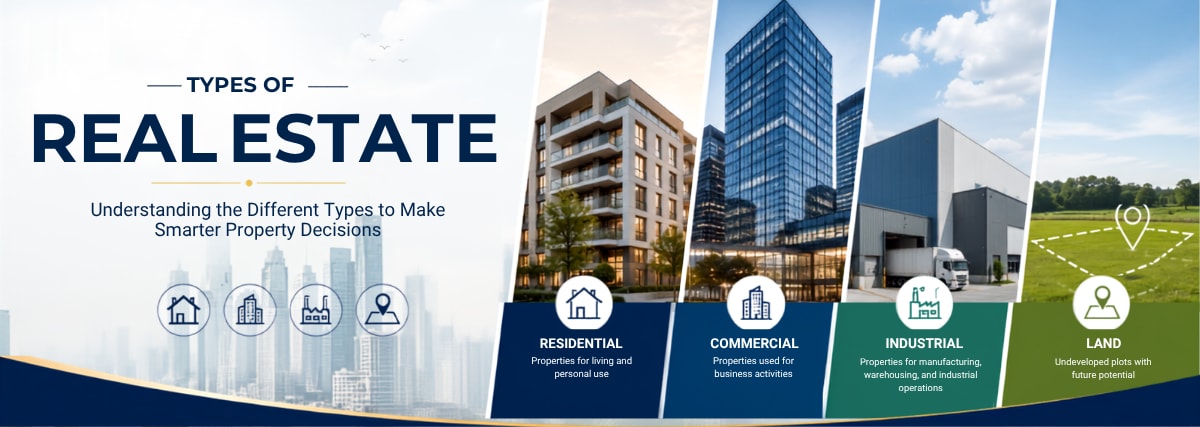
Residential real estate covers apartments, independent houses, villas, and builder floors, any property where the primary use is human habitation. Commercial real estate covers offices, retail shops, warehouses, industrial units, co-working spaces, and mixed-use developments.
The strategic shift happening among modern investors is diversification across both asset classes. Rather than choosing one, experienced investors treat residential property as a wealth-preservation engine and commercial property as a cash-flow machine, running them in parallel to balance risk and return.
2. Core Structural & Operational Differences
Lease Longevity
This is where the two asset classes diverge most sharply in day-to-day management.
Residential leases in India typically run on 11-month cycles (to avoid mandatory registration) or extend up to 36 months. That means a landlord may renegotiate rent, screen new tenants, and absorb vacancy gaps every one to three years, a recurring operational overhead.
Commercial leases, by contrast, typically lock in for 3 to 9 years, with rent escalation clauses built in (usually 15% every 3 years). Once a quality tenant signs a commercial lease, the landlord's job is largely administrative. The longer tenure is also why commercial tenants invest heavily in their own fit-outs, they know they'll be there long enough to extract value from the investment.
Tenant Dynamics
In residential property, your tenant is an individual or a family. Disputes can be personal, emotional, and slow to resolve. In commercial property, your tenant is a registered business entity, a company with directors, a legal address, and reputational accountability. Corporate tenants are less likely to default without notice, and disputes tend to be contractual rather than personal.
This "professionalism premium" is one of the underrated advantages of commercial real estate. When a company signs your lease, you can verify their GST returns, assess their creditworthiness, and hold a legal entity accountable, none of which applies to an individual tenant.
Size & Scale Requirements
Commercial properties have a minimum viable area concept that residential properties do not. A 400 sq ft apartment is perfectly rentable to a couple or a solo professional. A 400 sq ft commercial space may only attract small kiosks or pop-up retail, limiting your tenant pool significantly.
Quality commercial tenants, IT companies, banks, clinics, coworking operators, typically require 1,000 sq ft at minimum, and most mid-sized businesses look for 2,000–5,000 sq ft. This means commercial investing demands larger capital allocation upfront, which is both its barrier to entry and its moat.
3. The Financial Breakdown: Commercial vs Residential Property ROI
Gross vs. Net Yields
Net yield is what actually matters, the income that reaches your pocket after maintenance, property taxes, management fees, and vacancy-related losses.
A residential flat worth ₹1 crore might generate ₹20,000–25,000/month in rent. A commercial property of the same value, say, a ground-floor retail unit in a commercial corridor, could realistically generate ₹50,000–80,000/month. The gap isn't marginal; it's transformational for investors depending on monthly cash flow.
Annual Rental Appreciation
Here is where residential property partially closes the gap: residential rents grow faster annually than commercial rents.
Residential rents appreciate at roughly 5–7% per year, driven by inflation, population growth, housing demand, and the relatively low cost of switching tenants to get a market-rate revision. Commercial rents, anchored by long lock-in periods and pre-agreed escalation clauses, typically grow at 3–5% annually.
This doesn't negate commercial property's yield advantage, it simply means commercial rents compound more slowly. Over a full market cycle, commercial still wins on absolute cash-flow generation.
Total Return Forecast: 10-Year Horizon
When you combine rental income and capital appreciation over a decade, the picture becomes clear:
Residential property delivers approximately 8–9% total annual ROI, a combination of moderate rental yield and steady capital appreciation driven by urban housing demand.
Commercial property delivers approximately 13–15% total annual ROI, powered by higher net yields, longer leases that guarantee income continuity, and capital appreciation in well-located commercial corridors.
The compounding effect over 10 years means ₹1 crore invested in commercial real estate (in the right location) significantly outperforms the same capital deployed in residential, provided the investor can manage the higher entry threshold and lower liquidity.
4. Tax Benefits and Legal Frameworks
Residential Perks: The Indian Tax Advantage
Indian tax law actively incentivises residential property ownership through two mechanisms that commercial investors simply do not have access to:
Section 24(b) of the Income Tax Act allows a deduction of up to ₹2 lakh per year on home loan interest for a self-occupied property. For a let-out residential property, the entire interest paid on the home loan is deductible against rental income, a powerful benefit in the first several years of a loan when interest dominates EMI payments.
Section 80C allows deduction of up to ₹1.5 lakh per year on the principal repayment component of a home loan, along with stamp duty and registration costs in the year of purchase.
Together, these deductions can significantly reduce the effective cost of holding a residential property, especially for salaried investors in higher tax brackets.
Commercial Taxation
Commercial property income is taxed as standard business or rental income with no equivalent "homeowner" exemptions. GST at 18% applies to commercial rental income above the threshold, which adds a compliance layer (GST registration, quarterly filings, input tax credit management) that residential landlords are entirely exempt from.
That said, legitimate business expenses related to managing commercial property, repairs, property management fees, depreciation, are deductible, which partially offsets the disadvantage.
Regulatory Compliance
RERA (Real Estate Regulatory Authority) applies primarily to residential projects, providing buyer protections around delivery timelines, escrow requirements, and developer accountability. Commercial projects are partially outside RERA's scope, which means less regulatory oversight, and therefore higher due diligence responsibility on the buyer.
Municipal zoning laws are critical in commercial property. A property zoned for residential use cannot legally be converted to commercial without a change-of-use approval, which is expensive, time-consuming, and not always granted. Always verify the municipal zoning classification, and the permitted usage, before purchasing a commercial asset.
5. Customization and Maintenance Responsibilities
The Shell Concept
Commercial properties are typically delivered in one of two conditions:
A Bare Shell unit is exactly what the name suggests, four walls, a floor, a ceiling, and basic electrical conduits. No flooring, no plumbing fixtures, no air conditioning, no false ceiling. The tenant takes the space and builds it out entirely at their own cost.
A Warm Shell unit includes finished flooring, basic electrical wiring, air conditioning infrastructure, and sometimes a false ceiling. The tenant completes the interiors, branding, partition walls, workstations, but starts from a more livable baseline.
This arrangement has a critical implication for investors: in most commercial deals, the tenant bears the cost of interior fit-outs. A retail brand spending ₹30–50 lakh fitting out a store becomes a stickier tenant, the sunk cost in the space makes them far less likely to vacate at the end of a lease cycle.
Maintenance and the Net Lease Structure
In many commercial leases, particularly with corporate tenants, the agreement is structured as a Net Lease (or triple net lease in more formal markets), where the tenant pays property taxes, building maintenance charges, and insurance directly, in addition to base rent. This significantly reduces the landlord's ongoing cash outflow compared to residential property, where all maintenance typically falls on the owner.
Residential owners, by contrast, continuously invest in aesthetics to maintain rental appeal, repainting kitchens, replacing wardrobes, upgrading bathrooms. These aren't optional; they directly affect rentability and pricing. Commercial tenants handle their own interiors entirely, which means the building's exterior and common areas are the landlord's only real maintenance responsibility.
6. Risk Assessment and Liquidity
Occupancy Risk
Vacancy is the real enemy of both asset classes, but it hits differently.
A residential vacancy in a well-located city apartment is typically bridged within 4–8 weeks. Housing demand is broad and deep, young professionals, families, students, corporate employees on temporary assignments are always looking. The sheer volume of potential tenants means a vacant residential property is an inconvenience, not a crisis.
A commercial vacancy is a different problem. The tenant pool for a 3,000 sq ft office or a large retail space is dramatically smaller. Finding the right business, negotiating terms, and executing a lease agreement takes months, sometimes 6–18 months in a slow market. During this period, the property generates zero income while the owner continues paying property tax, maintenance, and loan EMIs. This prolonged vacancy risk is the most significant downside of commercial real estate investing.
Capital Value Stability
Commercial real estate is peculiar in one important way: high rental yield does not always translate to high capital appreciation. A commercial property generating excellent rent may see its capital value stagnate if the broader commercial real estate market is oversupplied or if the micro-location loses relevance (think of older IT corridors being abandoned for newer tech parks).
Residential capital values, particularly in Tier 1 cities, tend to be more stable and directionally upward over long holding periods, even through economic slowdowns, because housing scarcity drives a structural floor.
The Liquidity Gap
Liquidity refers to how quickly you can convert your asset to cash without a significant price discount.
Residential properties in liquid markets, Mumbai's western suburbs, Bengaluru's tech corridors, Delhi-NCR, can often find a buyer within 30–90 days at a fair price. The buyer pool includes end-users (who buy to live), investors (who buy to rent), and NRIs, a wide and active market.
Commercial property has a much narrower buyer pool: primarily institutional investors, HNIs, or businesses buying for self-use. This means selling a commercial property, particularly a mid-sized standalone unit, can take 6–24 months. If you need liquidity quickly, you may be forced to accept a significant discount. This illiquidity premium is the price investors pay for commercial real estate's higher yields.
7. Which Path is Right for You?
Residential property is the better choice for long-term wealth preservation, predictable appreciation, tax savings, and easier liquidity. Commercial property is the better choice for higher monthly cash flow, stronger total ROI over a 10-year horizon, and professionally managed, lower-maintenance income.
Neither is universally superior, the right choice is specific to your capital, goals, and risk profile.
Choose residential if: you are a first-time investor with ₹50–₹1.5 crore to deploy, you value liquidity and the ability to exit cleanly within a year if needed, you want meaningful tax deductions on a home loan, or you have a long (15–20 year) horizon and want steady appreciation.
Choose commercial if: you have ₹1.5 crore or more in investable capital, you want higher monthly income from the first year, you are comfortable with a smaller exit pool and a longer potential holding period, and you are willing to put in more due diligence upfront, on zoning, tenant quality, lease terms, and location fundamentals.
The optimal strategy for serious investors is to hold both. Use residential property as the foundation, stable, tax-efficient, and liquid. Layer commercial and residential property together to build a portfolio where residential capital appreciation compounds steadily in the background while commercial income funds your current lifestyle or reinvestment.
Commercial vs residential property is not a binary competition. It is a portfolio architecture question. Understand what each asset class does well, deploy capital accordingly, and let compounding do the rest.